Afterlives / Interactive passage
A saint changes languages.
What happens when a printed figure enters another painter’s world?
Read through the records
1564
The intermediary
c. 1580–85
The original works remain with their source records. Follow the links below to view them alongside the argument.
An interactive passage / Select a stop
Move between the proposed source, the encounter and the remaking.
1564
An image multiplied
Cartaro’s engraving is a proposed model in a scholarly comparison. Open the catalogue to inspect its reproduction beside the painting.
Mario Cartaro, Saint Jerome in a Landscape
The Met’s Wonder of the Age catalogue identifies a European source for Kesu Das’s Saint Jerome and proposes Mario Cartaro’s 1564 engraving as the probable model.
Probable is part of the identification. This dossier does not claim a proven source impression.
Inspect this connection ↓The link preserves this stop and research version. Its social image represents the whole investigation.
Read the complete passage
1564 · An image multiplied
Cartaro’s engraving is a proposed model in a scholarly comparison. Open the catalogue to inspect its reproduction beside the painting.
The intermediary · A court with prints
Print circulation makes an encounter historically intelligible. The precise album, owner and moment of looking remain unidentified here.
c. 1580–85 · A painter makes decisions
The later work is a painting attributed through its inscription to Kesu Das. Its relationship to the print is a scholarly attribution with an explicit qualification.
01 / Close reading
The book remains open while the reader rests.
In the catalogue reproduction, the figure’s lowered head and relaxed limbs seem at odds with the book held against the body. A blue drapery gathers the pose into a sweep; behind it, a tree gives way to a hazy distant settlement. The image asks us to notice study and rest in the same figure.
The accompanying entry relates this painting to Cartaro’s engraving and discusses the combination of a reclining pose with Saint Jerome’s book. Compare the two reproductions on printed page 70. Attend to the painter’s handling of flesh, drapery and distance before treating the work as merely a print filled with colour.
02 / Open question
A model is probable; the remaking is visible.
The catalogue names Cartaro’s 1564 engraving as the probable source and places Christian prints in Mughal court albums. It does not identify the impression Kesu Das handled. That gap concerns the encounter, rather than whether there is anything specific to see in the later painting.
The distant city and the resting body give the painting different kinds of stillness: one retreats into haze, the other remains near enough to study. This is our reading of the reproduced work. It keeps the painter’s decisions in view while the exact route of the proposed print remains unresolved.
Keep the identities distinct
Works, people & carriers.
work
Mario Cartaro, Saint Jerome in a Landscape
1564
Probable source, as proposed in the catalogue; reproduction linked externally.
Open the source record ↗work
Kesu Das, Saint Jerome, Guimet MA 2476
c. 1580–85
No licensed image is reproduced here.
Open the source record ↗document
European prints circulating at the Mughal court
Late 16th century
Context for encounter; exact album and source impression unestablished.
Open the source record ↗The research stays attached
How we know.
Source verification and prose revised with AI assistance. Independent specialist review remains pending.
Editorial review · 2026-10-17
A resting body, a book and a hazy city make the proposed model a new painting.
Checked 2026-10-17 · a-saint-changes-languages.2
Download the research record ↓attributedThe Met’s Wonder of the Age catalogue identifies a European source for Kesu Das’s Saint Jerome and proposes Mario Cartaro’s 1564 engraving as the probable model.
Relationship: adaptation
Mario Cartaro, Saint Jerome in a Landscape Kesu Das, Saint Jerome, Guimet MA 2476
The limit: Probable is part of the identification. This dossier does not claim a proven source impression.
- Wonder of the Age: Master Painters of India, 1100–1900 ↗
Printed p. 70, catalogue entry 26: Saint Jerome
attributedThe Met situates Kesu Das’s engagement with European pictorial techniques in the circulation of prints and engravings at the Mughal court.
Relationship: transmission
European prints circulating at the Mughal court Kesu Das, Saint Jerome, Guimet MA 2476
The limit: General court circulation supplies context, not a documented hand-to-hand itinerary for this particular print.
- Khwaja Umar Saved from Pursuers, Hamzanama folio ↗
Opening catalogue discussion of Kesu Das
- Wonder of the Age: Master Painters of India, 1100–1900 ↗
Printed p. 70, catalogue entry 26: Saint Jerome
Source ledger · 2 records
scholarship · en
Wonder of the Age: Master Painters of India, 1100–1900 ↗
John Guy and Jorrit Britschgi / The Metropolitan Museum of Art
Checked 2026-10-17 · Institutional PDF. Relevant source passage checked in the institutional PDF; catalogue reproductions remain subject to their own image rights.
Locate: Printed p. 70, catalogue entry 26: Saint Jerome
Supports: Kesu Das's painting, about 1580–85, is related to a European source, probably Mario Cartaro's engraving of 1564.
Limit: The exact engraving is proposed as probable. The wider ancestry of the pose is a separate scholarly argument; this dossier does not collapse it into direct contact.
object record · en
Khwaja Umar Saved from Pursuers, Hamzanama folio ↗
The Metropolitan Museum of Art
Checked 2026-10-17 · Source text. Relevant institutional record text checked through the research browser; direct scripted requests were rate-limited.
Locate: Opening catalogue discussion of Kesu Das
Supports: Context for Kesu Das's engagement with techniques in European prints circulating at court.
Limit: This is another work, attributed in part to Kesu Das, not evidence that the Saint Jerome source impression survives.
Public life: reach, response, consequence
Reach. The catalogue places Christian prints in Mughal court albums, providing context for access without documenting this encounter.
Response. The catalogue’s interpretation of the painter’s sources is distinct from a statement by Kesu Das.
Consequence. The specific painting and proposed model support a qualified adaptation study. Court-wide or religious consequences are not inferred from this one work.
Versions & corrections
- a-saint-changes-languages.1 · 2026-10-17
First source-checked review edition. Historical claims and original readings are distinguished; image permissions are recorded separately.
- a-saint-changes-languages.2 · 2026-10-17
Inspected printed page 70 of Wonder of the Age, including the paired reproductions. Kept Cartaro’s engraving probable and the exact source impression unidentified. Replaced general discussion of translation with a reading of drapery, rest, book and distance.
Historical source assertions, editorial readings and image decisions are separate. A revision changes the research version and regenerates dependent summaries and exports.
Suggest a correction →The story branches
Carry a question forward.
These are editorial reading suggestions. Each investigation makes its own argument.
Follow translation into another setting.
An image made of feathers.
What changes when a printed scene is remade in iridescence?
A connection attributed in the research
Follow the passageFollow prints into another setting.
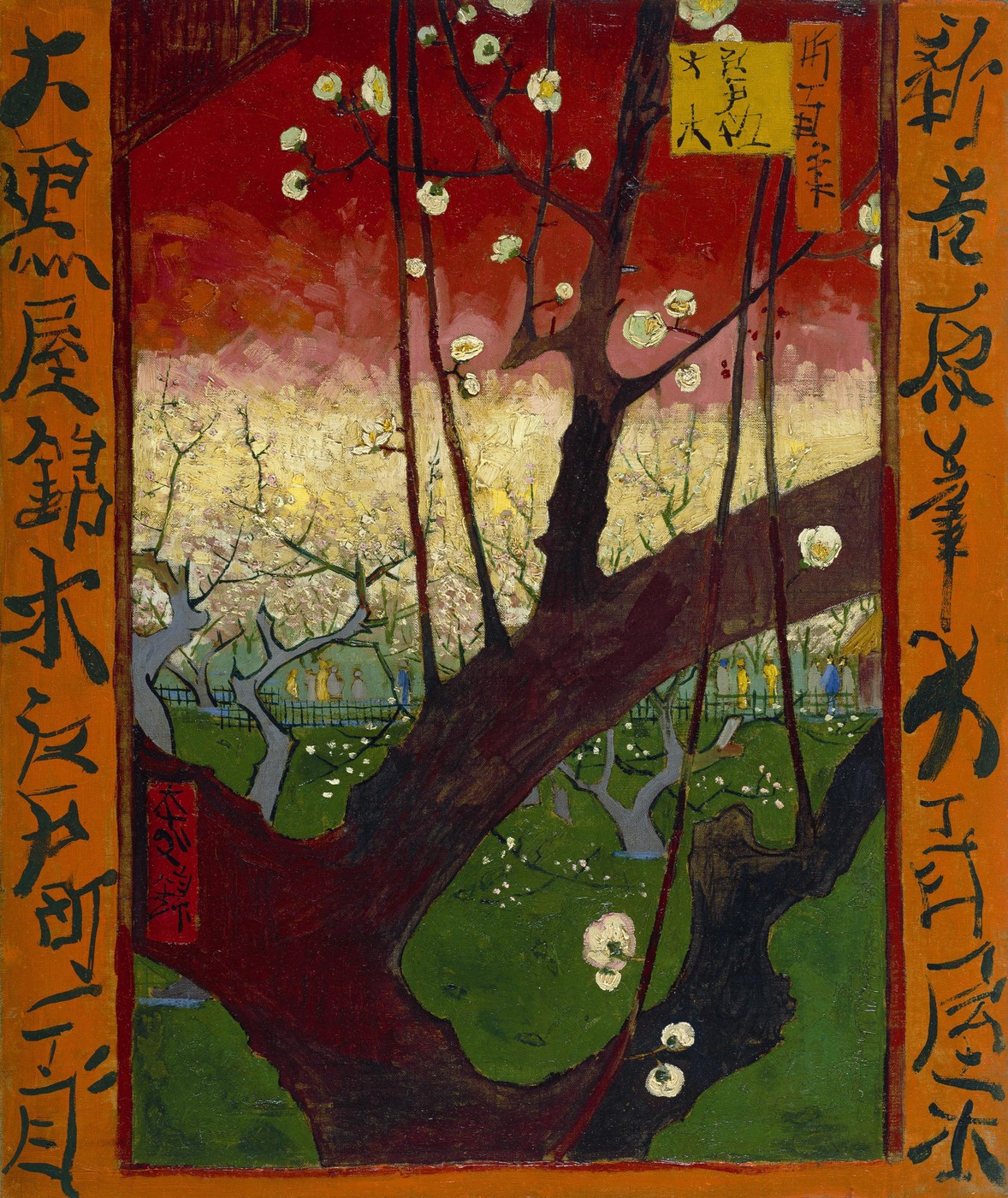
Flowering Plum Orchard (after Hiroshige)
- Maker
- Vincent van Gogh
- Date
- 1887
- Collection
- Van Gogh Museum / Wikimedia Commons
- Accession
- s0115V1962
- Credit
- Van Gogh Museum, Amsterdam (Vincent van Gogh Foundation). Google Art Project reproduction via Wikimedia Commons; file marked public domain as a faithful reproduction of a two-dimensional public-domain work.
- Rights
- Public Domain
A tree crosses the page.
A documented connection
Follow the passage