A small gesture,
carried forward.
Millet. A photograph. Van Gogh.
What can a copy carry?
Follow the documented passage into a painting, then compare two versions of a family’s first steps. Keep an eye on the space between what we can see and what we can establish.
01 / Follow the passage
The image takes a journey.
The dates mark episodes, not evenly spaced intervals.
c. 1859–66
A scene worth returning to
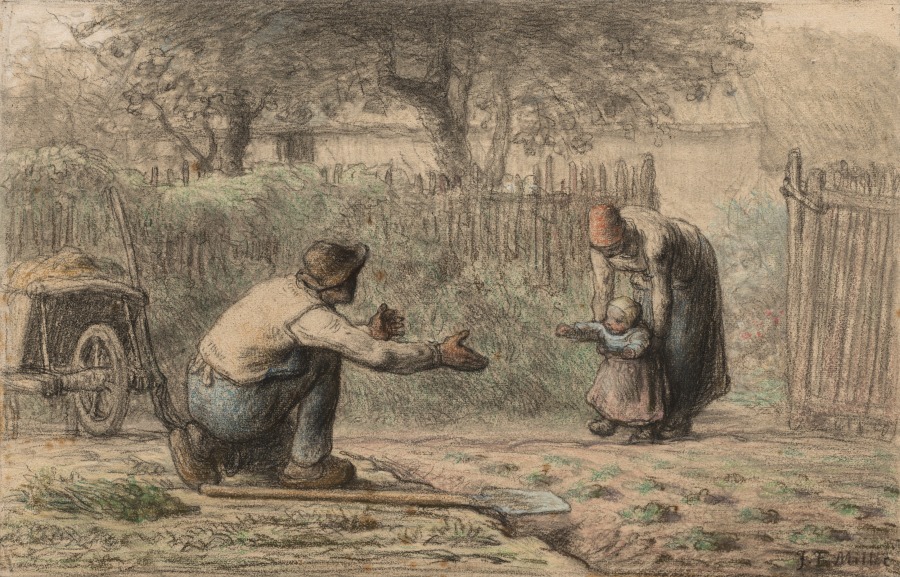
Millet’s Cleveland drawing places a child between two adults in a garden. Chalk and pastel give the scene both a drawn structure and touches of colour.
Museum record · comparison version [01]
This is a surviving version of the subject. Its identity as the sheet behind Vincent’s photograph is not established by the sources checked here.
Read all four episodes as text
c. 1859–66 · Museum record · comparison version
A scene worth returning to
Millet’s Cleveland drawing places a child between two adults in a garden. Chalk and pastel give the scene both a drawn structure and touches of colour. [01]
This is a surviving version of the subject. Its identity as the sheet behind Vincent’s photograph is not established by the sources checked here.Before January 1890 · Documented intermediary
The image travels without the drawing
A photograph sent by Theo gave Vincent access to Millet’s composition. The scholarly edition records the grid he added to transfer it. [03][02]
The historical photograph is held by the Van Gogh Museum (t*51). Follow the source to inspect it; no reconstructed photograph is presented here.On or about 13 January 1890 · Artist’s stated intention
A copy can be a translation
Writing to Theo, Vincent compares his work after Millet to translating monochrome into colour. He also plans to begin First Steps. The photograph supplies the arrangement; colour remains something for the painter to interpret. [04]
The letter discusses several works after Millet. It does not tell us how every viewer later understood this painting.January 1890 · Documented adaptation
The gesture enters another surface
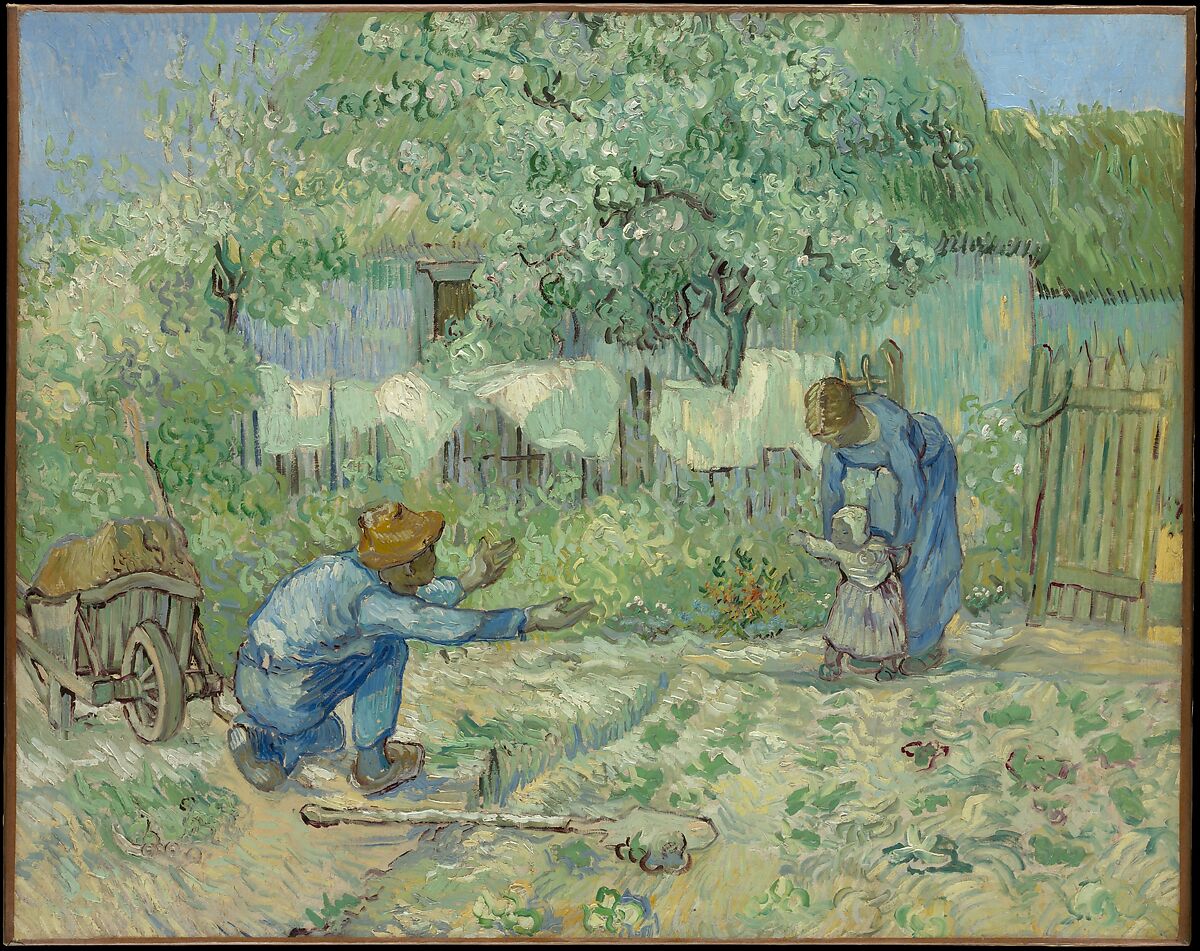
The Met dates First Steps, after Millet to 1890. The composition becomes an oil painting: the source account establishes the photographic route, while the comparison below lets you examine the visible differences. [02][03]
A documented artistic relationship does not by itself establish a broader social consequence.
02 / An Artologium visual reading
What stays. What changes.
Compare the Cleveland drawing with the Met painting. This pairing does not identify the exact sheet photographed for Vincent.
The space between the hands
Follow the father’s reach toward the child, then the supporting adult behind. The open interval between them holds the action in both images.
Where does your eye pause before the child takes a step?
Editorial observation · guides mark areas for attention, not historical evidence. Open either image for the unmarked view.03 / Effects, intentions, limits
What changed—and for whom?
There is evidence of artistic adaptation and an ambition to reach an audience. A wider social effect needs its own evidence.
Artistic practice
Documented adaptationAudience
Stated ambitionThe wish to reach more people
Vincent argues that his work after Millet could help bring Millet to a wider public. This records a purpose; the sources here do not measure its success. [04]
Social context
Context for Millet’s practiceRural subjects were not neutral to every viewer
Cleveland notes that critics treated Millet’s peasant imagery as politically radical. That broader reception should not be assigned automatically to this drawing or its later adaptation. [01]
04 / The evidence stays attached
Read the connections.
Four relationship records. Each names its basis and its limits.
Theo sent Vincent a photograph of Millet’s First Steps. [03][02]
The photographed source sheet is not equated here with Cleveland 1962.407.Vincent used the gridded photograph to transfer the composition into his painting. [03][02]
The intermediary is documented; its image is not reproduced in this investigation.Vincent discusses translation into colour and names First Steps among his intended subjects. [04]
His remarks also concern a wider series of works after Millet.Compare the reaching figures and the space between them in the Cleveland drawing and the Met painting. [01][02]
A comparison of versions does not establish that this exact drawing was Vincent’s source.Source ledger
01First Steps, Jean-François Millet, c. 1859–66Museum catalogue
Cleveland Museum of Art
Where to look: Object details; Did You Know?; Description
Supports: Identifies the Cleveland drawing, its materials and date. Discusses criticism of Millet’s peasant subjects and the market for his pastels.
Limit: These contextual statements concern Millet’s practice. They do not measure this particular drawing’s effect on society or identify the sheet photographed for Vincent.
Read the original source ↗02First Steps, after Millet, Vincent van Gogh, 1890Museum catalogue
The Metropolitan Museum of Art
Where to look: Opening catalogue commentary; Artwork Details; Public Domain designation
Supports: Identifies the painting and states that Vincent transferred the composition from a photograph sent by Theo, using a grid.
Limit: The account establishes adaptation through a photograph. It does not establish a measured public response to the painting.
Read the original source ↗03Letter 815, note 14Scholarly annotation
Van Gogh Museum / Huygens ING, Vincent van Gogh: The Letters
Where to look: Note 14; photograph identified as Amsterdam, Van Gogh Museum, t*51
Supports: Records the photograph Theo sent and the grid Vincent added. The historical photograph is a separate object from the Cleveland drawing displayed here.
Limit: Its image is linked at the scholarly edition; reproduction rights have not been cleared for Artologium. We do not substitute a simulated photograph.
Read the original source ↗04Letter 839, on or about 13 January 1890Artist’s letter in a scholarly edition
Vincent van Gogh to Theo van Gogh; edited by Leo Jansen, Hans Luijten and Nienke Bakker
Where to look: Folio 1r:1 on translation; 1v:2 on public access; 2v:7 on First Steps
Supports: Vincent explains his approach to translating monochrome works into colour, his admiration for Millet, his hope of reaching the public, and his plan to paint First Steps.
Limit: An artist’s intention is evidence of an ambition, not proof that the intended social effect occurred. The edition gives an approximate date.
Read the original source ↗Research note. Version first-steps.2; sources checked 2026-10-17. Research and visual commentary prepared with AI assistance. Source checks establish what these references say. An AI-assisted source and prose review is complete; independent specialist review remains open.
Both displayed images are institution-designated public domain / CC0. Open an image for its credit, rights policy and original record. The historical photograph is a separate, reference-only object. The evidence download includes image checksums and rights records; scholarly text is cited, not licensed as part of the images.
Continue looking