The essays / Pictures played
A pattern becomes a place to play.
When does looking become an action?
William Morris & Sophia George / Textile → gameBegin with the works
A bird inside a repeat is always on the verge of moving. Its beak points somewhere; a nearby fruit seems to offer a destination. The textile holds those possibilities still. A game can turn them into actions that take time. What passes between the two media is therefore more than an image: it is a possibility for attention to become movement.
Documented adaptation · original looking exerciseThe V&A documents George’s game and its inspiration. Cleveland’s later textile printing is our comparison image; Artologium’s study is an independent exercise, not the game.
01 Close reading
A still pattern can organize a sequence.
An Artologium close-looking study
a bird.From looking
to moving
A character, already waiting. Our close reading: begin with the bird’s eye and the curve of its body. A small figure gives your eye somewhere to enter.
Cleveland Museum of Art · CC0 · annotated detail.
Our study, distinct from Sophia George’s game.
Try the pattern in motion
An Artologium experiment
when it repeats?
Motion is off to respect your preference. Change the repeats to explore. Sample from Cleveland’s c. 1936 printing; our experiment is distinct from Sophia George’s game.
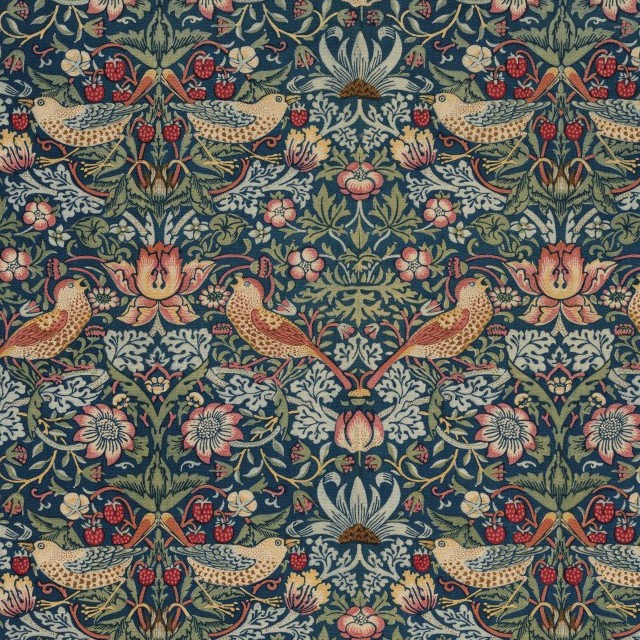
Look for one bird before trying to grasp the whole textile. Its body gathers small marks into a recognizable figure. The surrounding leaves and fruit compete for attention, but the figure gives the eye somewhere to start. Recognition makes a temporary foreground within an otherwise dense field.
Now search for a corresponding bird. The eye can leap across ornament to find it. That jump is already a small sequence: notice, search, recognize. Nothing in the textile has animated, yet your experience of it has acquired a before and an after.
Our study isolates bird, fruit and return as three possible stops. They are an authored way of looking, not instructions discovered inside Morris’s design. Another reader might begin with a stem, a colour interval or the spaces between figures and arrive at a different sequence.
02 Documented history
A designer gives the bird a task.
Dawn Hoskin’s V&A post of 24 October 2014 announces Sophia George’s iPad game and names Morris’s textile as its inspiration. A contemporary preview by Laura Southall, dated 8 August, describes using a finger to steer the bird as the pattern develops through sketch, colour and texture.
Southall also credits George’s team of Abertay students and graduates, with sound designed by the Royal Scottish National Orchestra. The adaptation has people behind it: game design, animation and sound turn the textile’s possible routes into a sequence of actions. The preview describes a work still being refined; it should not be treated as a technical specification of every released version.
03 Documented history
The pattern and the piece of cloth have different dates.
The design dates to 1883; the Cleveland textile reproduced here is dated about 1936. It is a later physical instance of a design that remained in circulation. The V&A account refers to the museum’s own textile, T.586-1919. Our Cleveland photograph is not evidence that George used this particular piece of cloth.
04 Context & interpretation
The finger adds a before and an after.
Southall’s preview describes flowers replenishing energy and bees and beetles taking it away. A fruit-and-bird pattern has become a field of possibilities and constraints: some encounters sustain movement, while others interrupt it. That is a more specific transformation than making the textile move.
Compare that account with our still-image looking study. Here, your eye chooses a route through bird, fruit and return. In the game account, a finger issues a direction and the program responds. The two sequences share a design reference but distribute agency differently.
The contemporary posts establish a public preview and launch. They do not measure lasting changes in players’ knowledge of Morris. What they do preserve is a moment when a museum textile was made available as something to navigate, accompanied by new animation and sound.
Your turn to look
Where would you begin if this pattern were a journey?
Use the three-stop looking study earlier in this essay, then choose a different starting point in the complete textile. Explain what your route brings forward and what it leaves in the background.
Return to the works ↑What this comparison can establish
The study in this essay uses Cleveland’s CC0 textile image. It neither reproduces George’s game nor reconstructs a historical Morris repeat. The launch is documented; current availability of the original app is not asserted.
The research stays attached
How we know.
Source verification and prose revised with AI assistance. Independent specialist review remains pending.
Editorial review · 2026-10-17
A bird becomes something a finger can guide through a pattern.
Checked 2026-10-17 · a-pattern-becomes-a-place-to-play.2
Download the research record ↓documentedThe V&A documents George’s game and its inspiration. Cleveland’s later textile printing is our comparison image; Artologium’s study is an independent exercise, not the game.
Relationship: adaptation
The limit: The study below uses Cleveland’s CC0 textile image. It neither reproduces George’s game nor reconstructs a historical Morris repeat. The launch is documented; current availability of the original app is not asserted.
- Dawn Hoskin: More Strawberry Thieves? (24 October 2014) ↗
V&A launch account: named designer, residency, source design and the V&A’s textile object.
documentedLaura Southall’s 8 August 2014 V&A preview describes finger-guided bird movement revealing sketch, colour and texture, with flowers restoring energy and insects reducing it.
Relationship: catalogue fact
The limit: The account describes the preview before the October launch, not every released version or a current installation.
- Laura Southall: Glorious Games in Digital Dundee (8 August 2014) ↗
Contemporary V&A preview describing finger control, sketch/colour/texture, energy, the Abertay team and RSNO sound. The preview precedes the October launch.
documentedThe V&A launch post identifies its textile T.586-1919 and an 1883 design; Cleveland dates the displayed later printing about 1936.
Relationship: catalogue fact
The limit: Cleveland’s cloth is a comparison printing, not the V&A source textile used in the game’s development.
- Dawn Hoskin: More Strawberry Thieves? (24 October 2014) ↗
V&A launch account: named designer, residency, source design and the V&A’s textile object.
- Cleveland Museum of Art: Strawberry Thief ↗
Object 1937.696: the later printing shown here, design attribution and CC0 image.
Source ledger · 3 records
institutional account · en
Dawn Hoskin: More Strawberry Thieves? (24 October 2014) ↗
Dawn Hoskin
Checked 2026-10-17 · Source text. Relevant source text and its stated object, date or license fields were inspected; this does not imply independent specialist review.
Locate: V&A launch account: named designer, residency, source design and the V&A’s textile object.
Supports: V&A launch account: named designer, residency, source design and the V&A’s textile object.
Limit: The study below uses Cleveland’s CC0 textile image. It neither reproduces George’s game nor reconstructs a historical Morris repeat. The launch is documented; current availability of the original app is not asserted.
institutional account · en
Laura Southall: Glorious Games in Digital Dundee (8 August 2014) ↗
Laura Southall
Checked 2026-10-17 · Source text. Relevant source text and its stated object, date or license fields were inspected; this does not imply independent specialist review.
Locate: Contemporary V&A preview describing finger control, sketch/colour/texture, energy, the Abertay team and RSNO sound. The preview precedes the October launch.
Supports: Contemporary V&A preview describing finger control, sketch/colour/texture, energy, the Abertay team and RSNO sound. The preview precedes the October launch.
Limit: The study below uses Cleveland’s CC0 textile image. It neither reproduces George’s game nor reconstructs a historical Morris repeat. The launch is documented; current availability of the original app is not asserted.
institutional account · en
Cleveland Museum of Art: Strawberry Thief ↗
Cleveland Museum of Art
Checked 2026-10-17 · Source text. Relevant source text and its stated object, date or license fields were inspected; this does not imply independent specialist review.
Locate: Object 1937.696: the later printing shown here, design attribution and CC0 image.
Supports: Object 1937.696: the later printing shown here, design attribution and CC0 image.
Limit: The study below uses Cleveland’s CC0 textile image. It neither reproduces George’s game nor reconstructs a historical Morris repeat. The launch is documented; current availability of the original app is not asserted.
Public life: reach, response, consequence
Reach. The V&A records a public preview in August and launch on 24 October 2014. Current availability and download totals are not established.
Response. Southall’s preview describes play and credits the Abertay team and RSNO sound. It is not a player survey.
Consequence. A museum textile design became a named game with interactive rules. Lasting learning or participation outcomes have not been measured in the cited accounts.
Versions & corrections
- a-pattern-becomes-a-place-to-play.1 · 2026-10-17
Migrated into the shared dossier registry. Existing authored text, objects, image decisions and qualifications retained.
- a-pattern-becomes-a-place-to-play.2 · 2026-10-17
Replaced the broken PDF link with Laura Southall’s contemporary V&A preview. Distinguished the August preview from the October launch and credited the team and sound work. Made energy, route and response concrete while preserving the distinction between the game and Artologium’s study.
Historical source assertions, editorial readings and image decisions are separate. A revision changes the research version and regenerates dependent summaries and exports.
Suggest a correction →Follow the evidence
Sources & image records.
Research and original readings developed with AI assistance. Independent editorial review is pending. Updated .
How we work →- Dawn Hoskin: More Strawberry Thieves? (24 October 2014) ↗
V&A launch account: named designer, residency, source design and the V&A’s textile object.
- Laura Southall: Glorious Games in Digital Dundee (8 August 2014) ↗
Contemporary V&A preview describing finger control, sketch/colour/texture, energy, the Abertay team and RSNO sound. The preview precedes the October launch.
- Cleveland Museum of Art: Strawberry Thief ↗
Object 1937.696: the later printing shown here, design attribution and CC0 image.
Credits, licenses & the images shown here
Strawberry Thief
William Morris (British, 1834–1896) · c 1936 · Cleveland Museum of Art, 1937.696.
Gift of Mrs. Henry Chisholm
Resized full photograph. A square detail crop is tiled in the separate repeat study; it does not reconstruct the original repeat unit. The complete sample remains available.