Afterlives / Connection study
A bowl without a passport.
How far can a form travel beyond the history of one object?
A way into this story
Look at the object; read the route at the scale of a type.
Here
One bowl
The museum record identifies this small glass vessel. The photograph shows its weathered surface; the catalogue supplies the account of cutting.
Inspect the evidence ↓Elsewhere
Related examples
The Shōsō-in catalogue identifies a separate bowl, Middle Storehouse 68, with a qualified Sasanian-Persian attribution. Open its Japanese record alongside the Met bowl.
Inspect the evidence ↓Between
A proposed passage
A probable mode of transport is useful context. It is not a passport for this particular object.
Inspect the evidence ↓
01 / Close reading
A surface can conceal its own making.
Follow the changing sheen around the bowl: pale patches interrupt a greenish body, while its lip catches a thin line of light. The catalogue describes cut and polished facets, but weathering makes their geometry difficult to distinguish in this view. Looking closely also means recognizing what a photograph does not let us see.
The museum also describes weathering. What the photograph shows is therefore a surviving surface, not an untouched reconstruction of its first appearance. The distinction belongs in the reading: material change is another kind of afterlife.
02 / Open question
A named bowl in Nara gives the comparison another anchor.
The Met names Japanese contexts for related vessels, including the Shōsō-in at Nara. The Imperial Household Agency’s Japanese catalogue identifies Hakururi no wan, Middle Storehouse 68: a cut-glass bowl described as having been made in Sasanian Persia. That remains an attribution in the holding institution’s record. Neither it nor the Met’s account documents a complete itinerary for the bowl pictured here.
Keep the identities distinct
Works, people & carriers.
tradition
Late Sasanian faceted-glass bowl type
5th–7th centuries
Open the source record ↗work
Bowl with wheel-cut facets, Met 59.34
c. 6th–7th century
This object has no documented Japanese itinerary in the cited record.
Open the source record ↗work
Related vessels in Japanese contexts
6th–8th-century contexts
A group-level catalogue account, including the Shōsōin treasure; not one substituted source object.
Open the source record ↗work
Hakururi no wan (白瑠璃碗), Middle Storehouse 68
A separate bowl at Shōsō-in, Nara. Its catalogue’s Sasanian attribution is qualified; no image is reproduced here.
Open the source record ↗The research stays attached
How we know.
Source verification and prose revised with AI assistance. Independent specialist review remains pending.
Editorial review · 2026-10-17
A second named bowl anchors the type comparison without giving either an invented itinerary.
Checked 2026-10-17 · a-bowl-without-a-passport.4
Download the research record ↓attributedThe Met describes related Sasanian faceted bowls in Japanese contexts and proposes transport by Persian merchants and embassies as probable.
Relationship: circulation
Late Sasanian faceted-glass bowl type Related vessels in Japanese contexts
The limit: The examples and proposed transport concern a vessel type. The Met bowl is not documented as having traveled to Japan.
- Bowl with wheel-cut facets, 59.34 ↗
Opening three commentary paragraphs
attributedThe catalogue describes wheel-cut and polished facets, while qualifying whether the bowl’s initial shape was mold-blown or free-blown.
Relationship: catalogue fact
The limit: The manufacturing alternatives remain unresolved in this dossier.
- Bowl with wheel-cut facets, 59.34 ↗
Opening three commentary paragraphs
attributedThe Imperial Household Agency’s catalogue identifies Hakururi no wan, Middle Storehouse 68, and describes it as said to have been made in Sasanian Persia.
Relationship: catalogue fact
The limit: English wording here is an editorial paraphrase of the Japanese attribution. This is a separate object, not the Met bowl.
- 白瑠璃碗 (Hakururi no wan), Middle Storehouse 68 ↗
Japanese record: 倉番 中倉68, materials/technique and final explanatory sentence
Source ledger · 2 records
object record · ja; editorial English paraphrase
白瑠璃碗 (Hakururi no wan), Middle Storehouse 68 ↗
Imperial Household Agency, Shōsō-in Office
Checked 2026-10-17 · Indexed source text. Relevant indexed primary-source text checked. Direct scripted access was blocked, empty or incomplete; this is not recorded as a successful full-page retrieval.
Locate: 倉番 中倉68; material/technique and explanatory paragraph
Supports: A separate cut-glass bowl at Shōsō-in; the Japanese entry says it is thought to have been made in Sasanian Persia.
Limit: English descriptions are Artologium’s editorial paraphrases of the Japanese record. The qualified attribution does not document an individual trade itinerary.
object record · en
Bowl with wheel-cut facets, 59.34 ↗
The Metropolitan Museum of Art
Checked 2026-10-17 · Source text. Relevant institutional record text checked through the research browser; direct scripted requests were rate-limited.
Locate: Opening three commentary paragraphs
Supports: A Sasanian bowl type; examples found in Japanese contexts; proposed transport by merchants and embassies.
Limit: The Met bowl itself is not documented as having traveled to Japan. The commentary qualifies both manufacturing and transport hypotheses.
Public life: reach, response, consequence
Reach. Separate catalogue records locate related bowls in New York and Nara. The Met also describes wider Japanese contexts for the type.
Response. The institutional attributions and proposed transport are scholarly accounts, not testimony of an individual bowl’s journey.
Consequence. A named Japanese comparison strengthens the geographical question; it does not supply the pictured Met bowl with a Japanese provenance.
Versions & corrections
- a-bowl-without-a-passport.1 · 2026-10-17
First source-checked review edition.
- a-bowl-without-a-passport.2 · 2026-10-17
Visual verification: describe the weathered surface actually visible; distinguish the catalogue's account of cutting from details obscured in this photograph.
- a-bowl-without-a-passport.3 · 2026-10-17
Checked the Met’s manufacturing alternatives and qualified transport account. Added the Japanese holding institution’s record for Middle Storehouse 68. Retained the Japanese attribution’s qualification and labeled the English wording an editorial paraphrase.
- a-bowl-without-a-passport.4 · 2026-10-17
Checked the Met’s manufacturing alternatives and qualified transport account. Added the Japanese holding institution’s record for Middle Storehouse 68. Retained the Japanese attribution’s qualification and labeled the English wording an editorial paraphrase. Connected the Japanese reading panel to the named Shōsō-in entity and its own record.
Historical source assertions, editorial readings and image decisions are separate. A revision changes the research version and regenerates dependent summaries and exports.
Suggest a correction →The story branches
Carry a question forward.
These are editorial reading suggestions. Each investigation makes its own argument.
Follow uncertain routes into another setting.
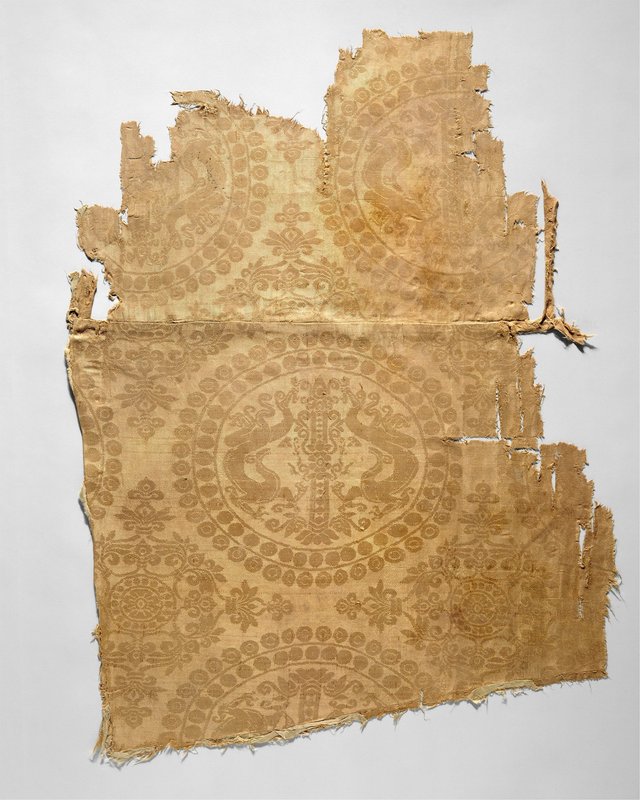
Textile with Pearl Roundels with Dragons
- Maker
- Maker unrecorded
- Date
- late 8th–9th century
- Collection
- The Metropolitan Museum of Art
- Accession
- 1998.147
- Credit
- Purchase, Barbara and William Karatz Gift, 1998
- Rights
- CC0
A border outlives an empire.
A connection attributed in the research
Open the connection studyFollow material into another setting.
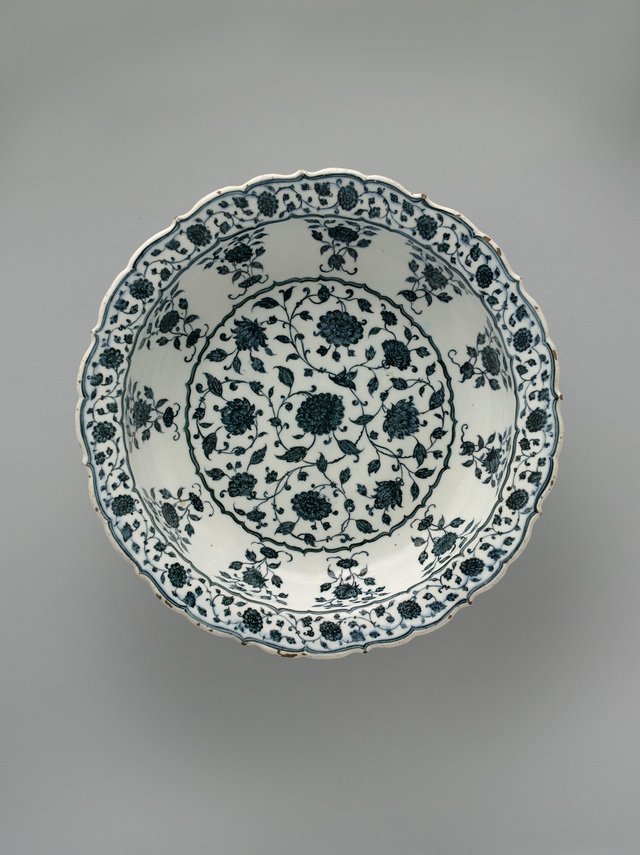
Footed Dish with Foliate Rim in Imitation of Chinese Porcelain
- Maker
- Maker unrecorded
- Date
- ca. 1570–80
- Collection
- The Metropolitan Museum of Art
- Accession
- 66.4.2
- Credit
- Harris Brisbane Dick Fund, 1966
- Rights
- CC0
A dish translates porcelain.
A connection identified by The Met
Read the visual essay