Afterlives / Visual essay
A blue that crossed borders.
What if the traveller is a material, rather than a picture?
A way into this story
Read colour as appearance, material and circumstance.
See
A blue in relation
Attend to blue beside paper, foam, boats and mountain. The image’s colours are preserved; no simulated pigment removal is used.
Inspect the evidence ↓Make
A pigment becomes available
The museum account connects a material opportunity with publishers. This brings production into the story without reducing it to one maker.
Inspect the evidence ↓Ask
Availability is not destiny
A pigment can enable choices without causing a particular composition. Trade history and pictorial decisions require different explanations.
Inspect the evidence ↓
01 / Close reading
Blue holds the wave and mountain in one field.
Begin with the curling mass of water, then find Fuji in the interval beneath it. The same image makes a nearby wave immense and a mountain small. Blue participates in that reversal through contour, darker masses and the spaces left for foam and paper.
Now look for differences within the blue areas. A darker contour and a pale field have different pictorial jobs. Their appearance on a screen cannot identify their pigments chemically; the material account comes from research, while these relationships are available to the eye.
02 / Historical account
A publisher belongs in the colour story.
The British Museum names Nishimuraya Yohachi as publisher and connects Prussian blue’s increasing availability through China with the print’s production context. That brings a practical question into the story: which materials could a publisher obtain and put into circulation through repeated impressions?
Our reproduction is the Met’s sheet; the quoted material context comes from the British Museum’s record. The design connects them, but a finding or purchase history about one impression cannot automatically be transferred to the other. Pigment circulation is broader than the provenance of one sheet.
03 / Open question
An available material still has to be composed.
Access to a strong blue gives makers possibilities. It does not explain the placement of the small mountain, the tension of the curved wave or the path of the boats. Those decisions ask to be read together with the material history.
Try following only the edges where blue meets unprinted-looking paper, then return to the complete composition. The colour’s public life includes both a route through trade and a set of contrasts that a particular image puts to work. The two histories meet without becoming the same explanation.
Keep the identities distinct
Works, people & carriers.
material
Prussian blue available to Japanese publishers through China
Late 1820s
Open the source record ↗design
Hokusai, Under the Wave off Kanagawa
c. 1830–32
The displayed Met impression is distinct from the British Museum record used for material history.
Open the source record ↗The research stays attached
How we know.
Source verification and prose revised with AI assistance. Independent specialist review remains pending.
Editorial review · 2026-10-17
A material route meets a publisher’s choices and a particular composition.
Checked 2026-10-17 · a-blue-that-crossed-borders.2
Download the research record ↓attributedThe British Museum connects the print’s Prussian blue to the pigment becoming cheaply available to Japanese publishers from China.
Relationship: circulation
Prussian blue available to Japanese publishers through China Hokusai, Under the Wave off Kanagawa
The limit: This is material context, not the documented supply chain for the particular Met impression displayed here.
- Under the Wave off Kanagawa, 2008,3008.1 ↗
Curator's comments on Berlin / Prussian blue
documentedThe British Museum identifies Nishimuraya Yohachi as the publisher of its Great Wave impression.
Relationship: catalogue fact
The limit: The publisher attribution does not document the pigment supplier or a purchase for the displayed Met sheet.
- Under the Wave off Kanagawa, 2008,3008.1 ↗
Producer name: Published by Nishimuraya Yohachi
Source ledger · 1 records
object record · en
Under the Wave off Kanagawa, 2008,3008.1 ↗
British Museum
Checked 2026-10-17 · Indexed source text. Relevant indexed primary-source text checked. Direct scripted access was blocked, empty or incomplete; this is not recorded as a successful full-page retrieval.
Locate: Curator's comments on Berlin / Prussian blue
Supports: The account connects Japanese publishers' access to inexpensive imported Prussian blue through China with the print's colour.
Limit: A pigment's availability is material context. It does not identify the supplier of the Met impression or explain every compositional choice.
Public life: reach, response, consequence
Reach. The source describes availability to Japanese publishers through China. It does not trace the materials in the displayed Met impression.
Response. Contour, mass and paper are compared visually; pigment identification is a separate research claim.
Consequence. Material access can enable choices. It is not presented as the sole cause of the composition or its later fame.
Versions & corrections
- a-blue-that-crossed-borders.1 · 2026-10-17
First source-checked review edition. Historical claims and original readings are distinguished; image permissions are recorded separately.
- a-blue-that-crossed-borders.2 · 2026-10-17
Checked the British Museum’s publisher and Prussian-blue context. Removed discussion of an unbuilt pigment-removal control. Separated visible colour relationships from chemical identification and from the Met sheet’s supply history.
Historical source assertions, editorial readings and image decisions are separate. A revision changes the research version and regenerates dependent summaries and exports.
Suggest a correction →The story branches
Carry a question forward.
These are editorial reading suggestions. Each investigation makes its own argument.
Follow prints into another setting.
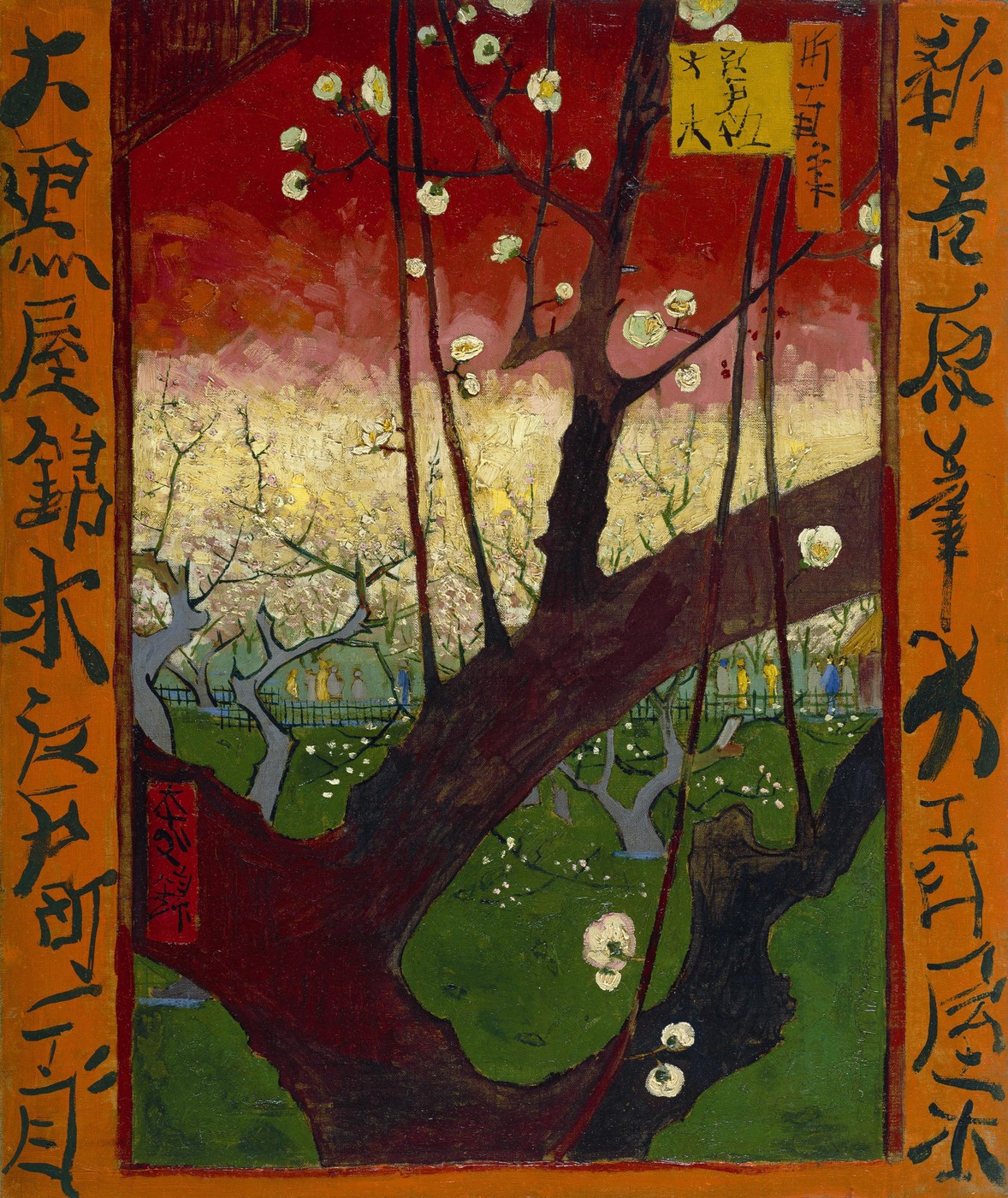
Flowering Plum Orchard (after Hiroshige)
- Maker
- Vincent van Gogh
- Date
- 1887
- Collection
- Van Gogh Museum / Wikimedia Commons
- Accession
- s0115V1962
- Credit
- Van Gogh Museum, Amsterdam (Vincent van Gogh Foundation). Google Art Project reproduction via Wikimedia Commons; file marked public domain as a faithful reproduction of a two-dimensional public-domain work.
- Rights
- Public Domain
A tree crosses the page.
A documented connection
Follow the passageFollow material into another setting.
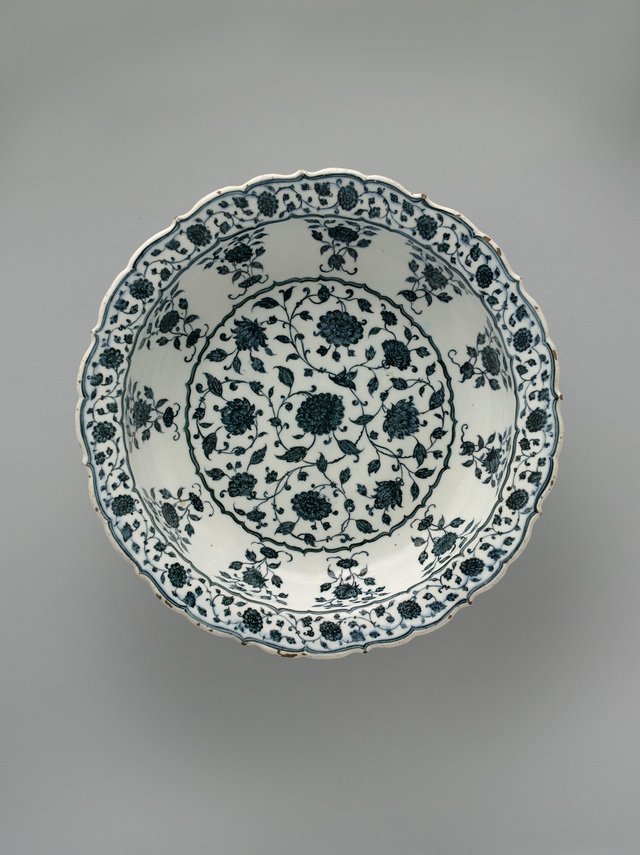
Footed Dish with Foliate Rim in Imitation of Chinese Porcelain
- Maker
- Maker unrecorded
- Date
- ca. 1570–80
- Collection
- The Metropolitan Museum of Art
- Accession
- 66.4.2
- Credit
- Harris Brisbane Dick Fund, 1966
- Rights
- CC0
A dish translates porcelain.
A connection identified by The Met
Read the visual essay