Afterlives / Connection study
A border outlives an empire.
Can an ornament remember a journey its object record cannot?
A way into this story
Read the circumference before the creature.
Border
A portable frame
Follow the repeated small circles. The frame is a motif with its own history; it need not travel with the same central figure.
Inspect the evidence ↓Centre
An unresolved creature
Examine the coiling figures without deciding in advance what the missing heads must mean.
Inspect the evidence ↓Gap
A route we cannot draw
The surviving fragment does not provide a sequence of workshops, merchants or owners linking Iran to its place of manufacture.
Inspect the evidence ↓
01 / Close reading
A frame with a history of its own.
Follow one ring of small circles before looking at the creature inside. The border closes a space; repeated across the silk, the same enclosure becomes a larger pattern. Along the ragged edge of the fragment, a roundel is interrupted by damage rather than by a finished design. The surviving piece lets us see both kinds of boundary.
The Met connects the pearl border with Sasanian Iran while placing this silk in China or Central Asia. A frame and the figure it encloses can therefore carry different historical associations. The fragment is more interesting as that encounter than as a passport stamped with one certain place of origin.
02 / Open question
Who gets to call a dragon incomplete?
The catalogue suggests a faulty weave program or a Central Asian maker less familiar with the dragon motif. Those are competing explanations offered by the museum, not established facts about the weaver. The missing heads alone cannot tell us whether a maker made an error, changed a form deliberately, or worked with a convention unfamiliar to the modern cataloguer. Keeping that question open also keeps the maker from disappearing behind an assumption of deficiency.
Keep the identities distinct
Works, people & carriers.
tradition
Sasanian pearl-border tradition
Sasanian period
Open the source record ↗work
Textile with Pearl Roundels with Dragons
Late 8th–9th century
China or Central Asia; place remains uncertain.
Open the source record ↗The research stays attached
How we know.
Source verification and prose revised with AI assistance. Independent specialist review remains pending.
Editorial review · 2026-10-17
The enclosing border has a different historical association from the creature inside.
Checked 2026-10-17 · a-border-outlives-an-empire.2
Download the research record ↓attributedThe Met relates this textile’s pearl-bordered ornament to Sasanian Iran; it attributes the fragment itself to China or Central Asia.
Relationship: circulation
Sasanian pearl-border tradition Textile with Pearl Roundels with Dragons
The limit: This is a catalogue argument about a motif tradition, not a documented itinerary for the fragment.
- Textile with Pearl Roundels with Dragons, 1998.147 ↗
Opening commentary and Artwork Details
attributedThe catalogue offers a weaving-program flaw or a Central Asian interpretation of dragon imagery as alternative explanations for the headless dragons.
Relationship: catalogue fact
The limit: Neither explanation is established. An unfamiliar form is not proof of a maker’s misunderstanding.
- Textile with Pearl Roundels with Dragons, 1998.147 ↗
Opening commentary and Artwork Details
Source ledger · 1 records
object record · en
Textile with Pearl Roundels with Dragons, 1998.147 ↗
The Metropolitan Museum of Art
Checked 2026-10-17 · Source text. Relevant institutional record text checked through the research browser; direct scripted requests were rate-limited.
Locate: Opening commentary and Artwork Details
Supports: Late eighth–ninth-century textile; China or Central Asia; the catalogue relates pearl borders to Sasanian Iran.
Limit: The proposed explanations for headless dragons are alternatives, not established events. No route for this fragment is documented here.
Public life: reach, response, consequence
Reach. The catalogue locates a motif tradition across regions; the fragment’s complete garment, furnishing and ownership history are not supplied.
Response. The explanations for headless dragons are modern catalogue proposals, not testimony by the weaver or contemporary viewers.
Consequence. The fragment supports a qualified account of ornament’s persistence; it supplies no documented travel itinerary.
Versions & corrections
- a-border-outlives-an-empire.1 · 2026-10-17
First source-checked review edition. Historical claims and original readings are distinguished; image permissions are recorded separately.
- a-border-outlives-an-empire.2 · 2026-10-17
Checked the Met’s exact place qualification and two proposed explanations. Made the fragment’s interrupted borders central to the close reading. Identified the catalogue’s maker-deficit explanation as speculation rather than a fact about Central Asian weavers.
Historical source assertions, editorial readings and image decisions are separate. A revision changes the research version and regenerates dependent summaries and exports.
Suggest a correction →The story branches
Carry a question forward.
These are editorial reading suggestions. Each investigation makes its own argument.
Follow uncertain routes into another setting.
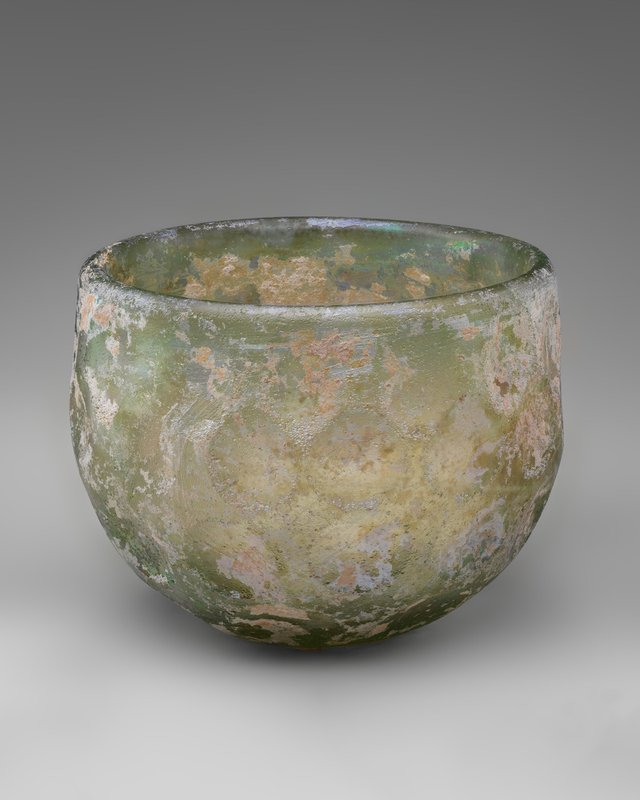
Bowl with wheel-cut facets
- Maker
- Maker unrecorded
- Date
- ca. 6th–7th century CE
- Collection
- The Metropolitan Museum of Art
- Accession
- 59.34
- Credit
- Rogers Fund, 1959
- Rights
- CC0
A bowl without a passport.
A connection attributed in the research
Open the connection studyCompare a different kind of transformation.
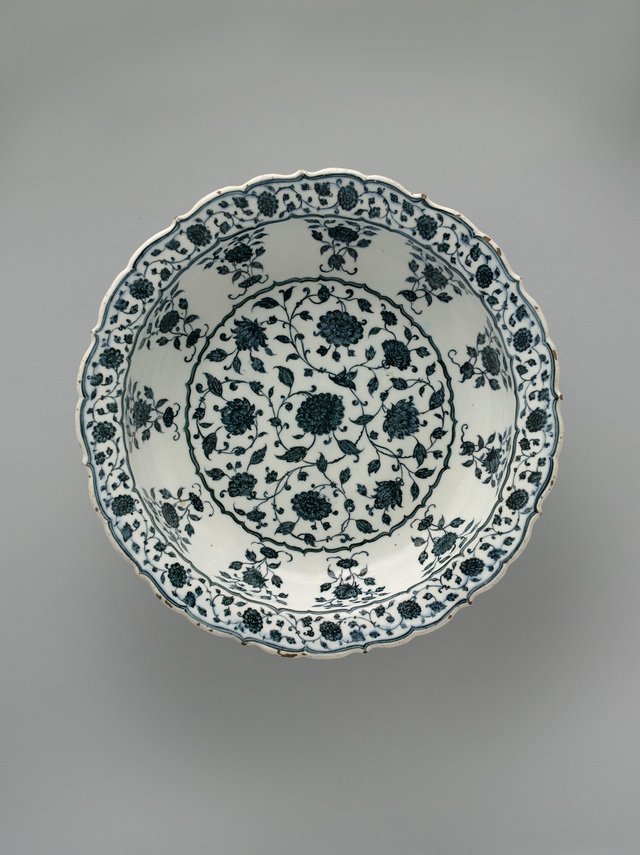
Footed Dish with Foliate Rim in Imitation of Chinese Porcelain
- Maker
- Maker unrecorded
- Date
- ca. 1570–80
- Collection
- The Metropolitan Museum of Art
- Accession
- 66.4.2
- Credit
- Harris Brisbane Dick Fund, 1966
- Rights
- CC0
A dish translates porcelain.
A connection identified by The Met
Read the visual essay
A frame with a history of its own.
Follow one ring of small circles before looking at the creature inside. The border closes a space; repeated across the silk, the same enclosure becomes a larger pattern. Along the ragged edge of the fragment, a roundel is interrupted by damage rather than by a finished design. The surviving piece lets us see both kinds of boundary. The Met connects the pearl border with Sasanian Iran while placing this silk in China or Central Asia. A frame and the figure it encloses can therefore carry different historical associations. The fragment is more interesting as that encounter than as a passport stamped with one certain place of origin.
Original navigation drawing, not a textile tracing.